Consciousness and matter
The Brain Is a Tap, Not a Factory
Every lesion study, drug effect and dementia scan cited against the soul is predicted just as well by a brain that receives consciousness as by one that produces it — and one of my atheist guests conceded exactly that on air.
 Benjamin Watkins, David CaltonDo Souls Exist Discussion with David Calton and Benjamin Watkins
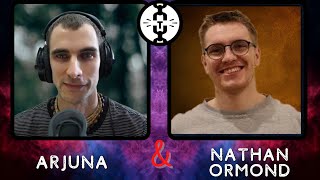 Nathan OrmondNathan & Arjuna discuss Dualism, Reincarnation and more
 Michael EgnorMichael Egnor Interview Problems for Materialism and Problems from Materialism
 Akhaṇḍādhi DāsaThe Mind Behind Atma Paradigm, a lecture series on consciousness & science with detailed metaphysics
 Benjamin WatkinsAn Atheist and a Theist Discuss Philosophy of Mind Dualism vs Monism
 Kane B, Michael Egnor, Unknown Audience Member B@TJump & Michael Egnor Debate Materialism
 Akhaṇḍādhi Dāsa, Michael EgnorInterfaith Discussion Vedanta vs Thomism, w Michael Egnor and Akhandadhi Das
 Akhaṇḍādhi Dāsa, James FodorMaterialism and the Nature of Consciousness Debate James Fodor vs Akhandadhi Das
 Aron Ra, Josh WolfeIs the Mind Material Aron Ra vs Josh Wulf (Sitapati)
 David PapineauDiscussion with David Papineau on Physicalism, Dualism and the Hard Problem of Conciousness
The argument I hear more often than any other, from comment sections to professional philosophers, runs like this: damage the brain and you damage the mind; therefore the brain makes the mind, and when the brain dies, you die. It is the sceptic's favourite argument because it feels like science rather than philosophy. No syllogisms, just stroke wards and MRI machines.
I have spent several years putting a particular reply to this argument in live debate — to an agnostic philosopher of religion, to one of the world's leading physicalists, and to an atheist who came on my channel specifically to defend the neuroscientific case. This article is the record of how those exchanges went. I think the record shows something most readers will not expect: the neuroscience everyone cites settles nothing, one of the ablest atheists I've hosted granted as much on air, and the evidence that remains once you see this points away from materialism, not towards it.
The strongest argument for materialism, stated properly
Before I argue against the production model, I want to state it at full strength, because the version that circulates online is usually weaker than the version serious philosophers defend.
The best formulation I've hosted came from Ben Watkins, an atheist philosopher who debated the existence of the soul on my channel opposite the Hasidic dualist David Calton. Watkins opened with what he called the argument from physical minds, built on five lines of evidence: stimulating the brain causes experiences; some injuries abolish experiences; the damage is region-specific, with particular sites tied to particular capacities; mental sophistication across the animal kingdom tracks neuronal complexity; and psychological traits are heritable through physical genetics. Together, he argued, these support the claims that mental changes have sufficient physical causes and that the mental supervenes on the physical. Souls, being purely non-physical minds, probably do not exist. [^1]
Notice how modest the conclusion is. Watkins was explicit about this:
"My claim in a nutshell is it's probable, it's more likely than not, that minds imply matter." [^2]
Not certain. Probable. That is the argument at its most careful. At its most blunt, it sounds like Aron Ra, who put the chemical version of it in a debate with Josh Wulf that I hosted early in the channel's life:
"If the brain can be altered, enhanced, and controlled by chemicals changing your mood, mental clarity, and even your personality chemically, that kind of proves that the mind really is chemical." [^3]
And behind both stands the historical argument David Papineau gave me when I raised the soul with him: science did not assume physicalism, it discovered it. Into the twentieth century, respectable scientists posited vital forces and nervous energies; the physiology of the 1950s convinced nearly everyone that only the ordinary physical forces operate in nerve cells, and any demonstration otherwise would win an immediate Nobel Prize. [^4]
So the case is: manipulate the brain, and the mind changes in lawlike, region-specific, dose-dependent ways. What could that be, if not production?
The tap and the water
Here is what I said when the agnostic YouTuber Nathan of Digital Gnosis and I debated dualism:
"All the evidence we have that the brain produces consciousness is actually comparable to evidence that a tap produces water. You fiddle with the tap and the water flow changes. You fiddle with the brain and consciousness changes." [^5]
Take the analogy seriously for a moment, because it is doing precise work, not decorative work. A tap controls water completely, as far as your kitchen is concerned. Open it and water flows; close it and water stops; damage one component and you get a specific, repeatable malfunction — a drip, a reduced flow, scalding heat when you wanted cold. Every one of those observations is lawlike, localised and dose-dependent. And not one of them shows the tap is the source of the water. The tap is an access point to something arriving from elsewhere, and everything you can do to the tap modulates your access, not the supply.
Now run Watkins's five evidences through that lens. Stimulation causing experiences: pressing on the mechanism disturbs the flow. Injuries abolishing capacities: breaking the mechanism cuts off access. Region-specificity: different components of the plumbing govern different functions. Every observation cited for production is predicted, in the same detail, by reception.
When I put the same argument to Michael Egnor, the Stony Brook neurosurgeon, I phrased it this way:
"All the evidence that anyone can offer to show that the brain produces consciousness is the same kind of evidence you might have that a tap produces water. You tinker with the tap and the flow of water changes."
Egnor, a Thomist who has operated on awake brains for decades, endorsed it without reservation, and added Aquinas's own version: composition with matter impairs mental powers, which is why the angels, having no bodies, are held to think better than we do. [^6]
I did not invent the image. I learned it from the Vaishnava philosopher Akhandadhi Das, who put it like this when I interviewed him about his Atma Paradigm lectures:
"It's like the brain, it's like a tap. You can turn it full open or half closed, or you can turn it off. But when you turn it on and the water comes out, the tap isn't the source of water." [^7]
The crucial move is this: brain damage removes access to a faculty, not the faculty itself. When a stroke takes a man's speech, the materialist says the speech-producing tissue is destroyed. The receptionist says the channel through which a still-existing mind expressed itself is destroyed. Both are looking at the same aphasic patient. I have also put it to Ben Watkins as lampshades over a white light — each covering dims and colours what shines through it, without generating the light. [^8]
At this point the sceptic usually suspects a trick. There is no trick, and you do not have to take my word for it, because the person who confirmed it was arguing for the other side.
An honest atheist's concession
The Watkins–Calton debate came to a head on exactly this question. Watkins had offered dementia as his strongest concrete evidence: brain scans predict the kind and degree of cognitive decline at each stage of the disease, physical facts forecasting mental ones with clinical reliability. Calton answered with the receiver model, stated as cleanly as I have ever heard it:
"A person who's damaged that part of the brain can't produce that phenomenon, not because that part of the brain produced that phenomenon, but because that part of the brain received that phenomenon." [^9]
Watkins could have fought this. Most internet atheists would have. Instead, he did the honest thing:
"It's one of those examples where our observations don't discriminate between the hypotheses. They're evidentially equivalent. The observations that they predict are what we will observe." [^10]
I want to dwell on what was just given away, because it is easy to read past it. The five neuroscientific evidences are the argument for materialism about the mind — not a supporting flank, the main force. Lesions, stimulation, region-specificity, dementia staging: this is the entire empirical case that the brain produces consciousness. And a philosopher who came on my channel to defend that case granted, on air, that all of it is predicted equally well by the hypothesis that the brain receives consciousness. Evidential equivalence means the data confer no advantage on either model. Every stroke ward and every MRI machine is neutral territory.
Which means that if you believe the brain produces the mind, you believe it for some reason other than the neuroscience. The lesion studies were never doing the work. Something else was.
The parsimony comeback, taken seriously
That something else has a name: parsimony. To their credit, the best of my opponents saw immediately that this was the fallback position, and argued it well.
Nathan's version: model choice is not only about fit to data but about cost. The reductionist model coheres with the rest of our best science while positing less — no second category of being, no soul with an unexplained interface to neurons. If both models fit the observations, take the leaner one. [^5]
James Fodor, a computational neuroscientist who debated Akhandadhi Das on my channel, gave the sharpest version. Ruling things out, he argued, is done by explanation: organic chemistry explained what the vital force was supposed to explain, and élan vital simply became surplus to requirements. Anything beyond the brain is in the same position:
"Postulates like that, as I think in science and in philosophy, they need to earn their keep. They need to show that they can provide us with explanatory purpose." [^11]
This deserves a straight answer, in three parts.
First, the experiencer is not a postulate. Élan vital was a theoretical entity inferred to explain observable chemistry; nobody ever met it. Consciousness is not inferred from data — it is the thing every datum arrives through, the one item in the inventory of the world you cannot coherently doubt. Akhandadhi's reply to Fodor made exactly this distinction:
"We're dealing with mental states, which have qualities, qualia, which are real. We're dealing with our experience of them as the experience of the subject. That's real. So these aren't new postulated entities." [^12]
When you delete élan vital, the chemistry remains and nothing is lost. When you delete the experiencer, the very observations parsimony was supposed to economise over go with it. A principle for choosing between explanations of the data cannot be used to delete the data.
Second, notice what the argument has become. The public position is that neuroscience refuted the soul. The actual position, after the concession, is that neuroscience is silent and a philosophical preference for desert landscapes settles the matter. That is a legitimate philosophical stance. It is not a scientific finding, and it should stop being sold as one. Watkins himself was candid that his view carries costs no experiment forced on him — that physicalism requires un-learning the most basic deliverances of experience:
"It seems like I am the author of my agency. These are very deeply ingrained assumptions in our phenomenology, and what I am saying is that those are mistaken." [^13]
As he put it to me in a later conversation, every position in philosophy of mind bites bullets somewhere; the discipline is choosing which. The materialist's simplicity is purchased, not free. [^14]
Third — and this is the decisive point — parsimony is a tie-breaker, and the tie it is supposed to break is not actually a tie. Ockham's razor tells you not to multiply entities beyond necessity when two models cover the same evidence equally well. But the two models do not cover the same evidence equally well. There is a class of cases where they come apart, and every one of them lands on the same side.
Where the filter leaks
Here is the asymmetry. On the production model, a damaged brain is a damaged generator: its output can only degrade. There is no reserve of mind anywhere else for it to draw on, ever, in any circumstances. On the reception model, a damaged brain is a damaged interface, and an interface can leak — the signal it normally constrains can occasionally get through anyway. So the models make different predictions after all. The generator model predicts that consciousness never outperforms its brain. The filter model permits exactly that. So the question becomes empirical again: does consciousness ever outperform its brain?
It does, in at least three places.
Terminal lucidity. Patients years deep into dementia, whose scans show exactly the structural devastation Watkins described, sometimes return in the last hours or days of life — recognising family, recalling names, speaking coherently — while the brain is at its worst. When Watkins pressed the cost of dualism on me, this was part of my answer: the brain's genuine explanatory successes never covered terminal lucidity, and a generator does not surge as it is destroyed. A tap being turned off, letting a final clear flow through a failing washer, is a far more natural picture than a factory resuming production while it is demolished. [^15]
Covert cognition. Adrian Owen's fMRI studies, which Michael Egnor detailed when he debated the materialist Tom Jump on my channel, found patients diagnosed as vegetative — no mental activity, by every bedside measure — whose brains responded to semantic instructions just as healthy volunteers' did, and who stopped responding when the words were jumbled. Comprehension was present; the machinery for expressing it was gone. Jump's reply was that brain patterns need not prove conscious thought, as blindsight shows rich processing without awareness. Fair enough as far as it goes — but the jumbled-word control is precisely the kind of detail that separates comprehension from reflex, and on the production model, a brain too damaged to express a mind has no business hosting one. [^16]
The seizure record. This one I owe to Egnor, who has seen more living human brains than almost anyone alive. Cortical stimulation and epileptic seizures can evoke movements, sensations, memories, emotions — the whole Penfield catalogue. What they never evoke is abstract thought:
"There are no calculus seizures, there are no logic seizures, there are no philosophy seizures, literature seizures. Why not? If the brain is the source of all of these thoughts, why wouldn't once in a blue moon a seizure make one of those thoughts happen?" [^17]
I used the same point against Watkins:
"There's never been a seizure where somebody did math incessantly in their head. There's all kinds of seizures, but we never have seizures that do something in the category of abstract thought." [^18]
Tom Jump's rebuttal to Egnor was that abstract thought might require a neural combination so precise that a seizure hitting it is like producing a word by smashing a thousand typewriter keys. It is a clever reply, and I would find it more persuasive if the denominator were smaller. Egnor's answer was blunt: hundreds of millions of seizures, hundreds of thousands of stimulations, and a numerator of zero. [^19]
I will mention the near-death evidence only briefly, because it deserves — and will get — its own article, and because I hold it to the standard my sceptical guests demand. Egnor's flagship case is Pam Reynolds, who with a flat EEG, a stopped heart and loud clicks in both ears accurately described instruments and conversations from her own aneurysm surgery; he estimates about one in five near-death reports contains checkable detail of this kind. When he raised it with me, I told him atheist YouTubers had produced a three-hour rebuttal of that very case and offered to host the debate — that is how I think this evidence should be handled, in the open, at its strongest and against its strongest critics. But note the shape of the claim: perception where the generator model says the generator was off. [^20]
None of these cases embarrasses the filter model, because a filter can leak. Every one of them embarrasses the generator model, because a generator cannot exceed itself. William James saw this over a century ago, and Egnor put James's conclusion to Akhandadhi Das and me in our interfaith discussion: the evidence, including minds that expand precisely as brain function fails, fits a brain that focuses and transmits the mind rather than secretes it. And this is where the parsimony argument finally inverts. Once there is data the leaner model cannot absorb, economy stops being a virtue. The materialist is no longer buying the same goods for less; he is buying fewer goods and calling the missing ones illusions. [^21]
What the Vedic model actually claims
I should say plainly what I am arguing for, because "the soul" means different things in different mouths, and the version I defend is older and more specific than the Cartesian ghost my opponents usually aim at.
In the Bhagavad-gita's account, the conscious self — the atma, the irreducible experiencer — is not produced by the body at any point. The Gita describes embodied souls as riding in a machine (yantra) made of material energy: the body, brain included, is an instrument the self operates and is constrained by, the way a driver is constrained by the vehicle's steering, speed and blind spots. This is why I told Egnor that on the Vedic view the soul occupies the body as a machine that limits its cognitive faculties — limitation is not an awkward addendum to the theory, it is the theory. [^6]
Notice what this model was never entitled to predict, if materialism were true. A tradition that held the brain to be the mind's source would have expected mental faculties to be safe wherever the brain is safe and lost wherever it is lost, full stop. A tradition that holds the body to be a limiting instrument expects tight mind-brain correlation as a matter of course — instruments constrain their users — while leaving room for the instrument to be bypassed at its edges: in dying brains, in damaged brains, in states where the machinery's grip loosens. That is the fingerprint the evidence actually shows.
Akhandadhi Das fills in the mechanics from the Vedantic side: between the brain and the atma sits the subtle mind, itself a fine grade of material energy, functioning as an interface — consciousness observes and operates through it the way a user works through a screen. Whatever one makes of the details, the point is that this is a worked-out position with a long intellectual history, not a gap dressed up as a theory. [^22]
So here is where the argument stands. The five best evidences for materialism about the mind do not discriminate between production and reception; a serious atheist philosopher conceded this on my channel, unprompted. The materialist's fallback, parsimony, is a philosophical preference presented as a scientific result, and it only operates when the remaining evidence is tied — which it is not, because terminal lucidity, covert cognition and the seizure record all sit on the reception side of the ledger, where the generator model cannot follow. Egnor's summary at the end of his debate with Tom Jump is the one I would put on the wall:
"What the brain does is not generate consciousness, it limits consciousness, it focuses consciousness, that human consciousness is in fact larger than what we experience." [^23]
Damage to the tap tells you about the tap. The water was never coming from there.
[^1]: Do Souls Exist? Discussion with David Calton and Benjamin Watkins (with Ben Watkins and David Calton), 00:01:08 — https://www.youtube.com/watch?v=NSYTTLklYk4&t=68 [^2]: Do Souls Exist? Discussion with David Calton and Benjamin Watkins (with Ben Watkins and David Calton), 01:29:07 — https://www.youtube.com/watch?v=NSYTTLklYk4&t=5347 [^3]: Is the Mind Material? Aron Ra vs Josh Wulf (Sitapati) (with Aron Ra and Josh Wulf), 00:16:04 — https://www.youtube.com/watch?v=SHXZgAnXhGg&t=964 [^4]: Discussion with David Papineau on Physicalism, Dualism and the Hard Problem of Consciousness (with David Papineau), 00:15:25 — https://www.youtube.com/watch?v=2cGXgbvKJy8&t=925 [^5]: Nathan & Arjuna discuss Dualism, Reincarnation and more (with Nathan of Digital Gnosis), 00:33:33 — https://www.youtube.com/watch?v=vhEdL3QClpE&t=2013 [^6]: Michael Egnor Interview: Problems for Materialism and Problems from Materialism (with Michael Egnor), 01:09:26 — https://www.youtube.com/watch?v=qVeKN5r-mT8&t=4166 [^7]: The Mind Behind Atma Paradigm (with Akhandadhi Das), 00:36:37 — https://www.youtube.com/watch?v=_yaKgUyX24s&t=2197 [^8]: An Atheist and a Theist Discuss Philosophy of Mind: Dualism vs Monism (with Ben Watkins), 00:34:42 — https://www.youtube.com/watch?v=0HrgaZKDzLI&t=2082 [^9]: Do Souls Exist? Discussion with David Calton and Benjamin Watkins (with Ben Watkins and David Calton), 01:48:43 — https://www.youtube.com/watch?v=NSYTTLklYk4&t=6523 [^10]: Do Souls Exist? Discussion with David Calton and Benjamin Watkins (with Ben Watkins and David Calton), 01:49:25 — https://www.youtube.com/watch?v=NSYTTLklYk4&t=6565 [^11]: Materialism and the Nature of Consciousness Debate: James Fodor vs Akhandadhi Das (with James Fodor and Akhandadhi Das), 01:24:29 — https://www.youtube.com/watch?v=MNIFsCCcap8&t=5069 [^12]: Materialism and the Nature of Consciousness Debate: James Fodor vs Akhandadhi Das (with James Fodor and Akhandadhi Das), 01:17:40 — https://www.youtube.com/watch?v=MNIFsCCcap8&t=4660 [^13]: Do Souls Exist? Discussion with David Calton and Benjamin Watkins (with Ben Watkins and David Calton), 01:16:39 — https://www.youtube.com/watch?v=NSYTTLklYk4&t=4599 [^14]: An Atheist and a Theist Discuss Philosophy of Mind: Dualism vs Monism (with Ben Watkins), 00:12:26 — https://www.youtube.com/watch?v=0HrgaZKDzLI&t=746 [^15]: An Atheist and a Theist Discuss Philosophy of Mind: Dualism vs Monism (with Ben Watkins), 01:24:07 — https://www.youtube.com/watch?v=0HrgaZKDzLI&t=5047 [^16]: TJump & Michael Egnor Debate Materialism (with Tom Jump and Michael Egnor), 01:23:40 — https://www.youtube.com/watch?v=aCTvHgWBpB4&t=5020 [^17]: Michael Egnor Interview: Problems for Materialism and Problems from Materialism (with Michael Egnor), 01:29:27 — https://www.youtube.com/watch?v=qVeKN5r-mT8&t=5367 [^18]: An Atheist and a Theist Discuss Philosophy of Mind: Dualism vs Monism (with Ben Watkins), 01:27:40 — https://www.youtube.com/watch?v=0HrgaZKDzLI&t=5260 [^19]: TJump & Michael Egnor Debate Materialism (with Tom Jump and Michael Egnor), 01:12:44 — https://www.youtube.com/watch?v=aCTvHgWBpB4&t=4364 [^20]: Michael Egnor Interview: Problems for Materialism and Problems from Materialism (with Michael Egnor), 01:16:39 — https://www.youtube.com/watch?v=qVeKN5r-mT8&t=4599 [^21]: Interfaith Discussion: Vedanta vs Thomism, with Michael Egnor and Akhandadhi Das (with Michael Egnor and Akhandadhi Das), 00:36:26 — https://www.youtube.com/watch?v=RM_rLip1a-c&t=2186 [^22]: Interfaith Discussion: Vedanta vs Thomism, with Michael Egnor and Akhandadhi Das (with Michael Egnor and Akhandadhi Das), 00:43:15 — https://www.youtube.com/watch?v=RM_rLip1a-c&t=2595 [^23]: TJump & Michael Egnor Debate Materialism (with Tom Jump and Michael Egnor), 02:36:37 — https://www.youtube.com/watch?v=aCTvHgWBpB4&t=9397
Episodes this draws on
- Do Souls Exist Discussion with David Calton and Benjamin WatkinsBenjamin Watkins, David Calton · Debate · 1h 55m
- Nathan & Arjuna discuss Dualism, Reincarnation and moreNathan Ormond · Lecture · 2h 19m
- Michael Egnor Interview Problems for Materialism and Problems from MaterialismMichael Egnor · Interview · 2h 16m
- The Mind Behind Atma Paradigm, a lecture series on consciousness & science with detailed metaphysicsAkhaṇḍādhi Dāsa · Lecture · 2h 31m
- An Atheist and a Theist Discuss Philosophy of Mind Dualism vs MonismBenjamin Watkins · Lecture · 1h 34m
- @TJump & Michael Egnor Debate MaterialismKane B, Michael Egnor, Unknown Audience Member B · Debate · 2h 43m
- Interfaith Discussion Vedanta vs Thomism, w Michael Egnor and Akhandadhi DasAkhaṇḍādhi Dāsa, Michael Egnor · Lecture · 2h 7m
- Materialism and the Nature of Consciousness Debate James Fodor vs Akhandadhi DasAkhaṇḍādhi Dāsa, James Fodor · Debate · 1h 59m
- Is the Mind Material Aron Ra vs Josh Wulf (Sitapati)Aron Ra, Josh Wolfe · Debate · 1h 22m
- Discussion with David Papineau on Physicalism, Dualism and the Hard Problem of ConciousnessDavid Papineau · Interview · 1h 59m
Comments
Comments are coming soon.